
Advantages and disadvantages of naked-eye 3D technology
Release date:
2021-05-12 11:25
Source:
From a technical perspective, autostereoscopic 3D can be divided into three types: grating, lenticular lens technology, and directed light source. autostereoscopic 3D The biggest advantage of this technology is that it eliminates the need for glasses, but there are still many shortcomings in terms of resolution, viewing angle, and viewing distance.
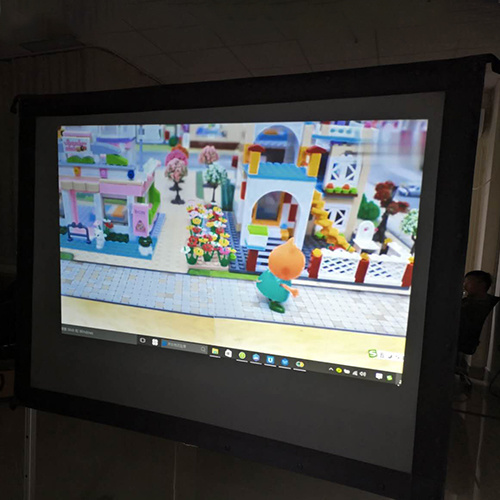
When viewing, the audience needs to maintain a certain position relative to the display device to view the 3D effect image (the 3D effect is greatly affected by the viewing angle), and there is still a certain gap between the 3D image and ordinary polarized 3D technology and shutter 3D technology. However, industry giants such as AU Optronics and R&D giant 3M have been actively conducting research and development, and it is expected that a large number of autostereoscopic 3D display devices will be mass-produced next year and the year after.
autostereoscopic 3D Advantages and Disadvantages
Grating - Grating autostereoscopic 3D technology is also known as parallax barrier or parallax barrier technology. Its principle is similar to polarized 3D. Engineers at Sharp's European laboratory have successfully researched it for more than ten years. Grating 3D products are compatible with existing LCD liquid crystal technology, so they have advantages in mass production and cost, but the image resolution and brightness of products using this technology will be reduced. A liquid crystal layer and a polarizing film are used to produce a series of vertical stripes with a direction of 90°.
autostereoscopic 3D Advantages: Compatible with existing LCD liquid crystal technology, thus having advantages in mass production and cost
autostereoscopic 3D Disadvantages: Low screen brightness, and resolution decreases inversely with increasing display.
Lenticular Lens - Lenticular lens technology is also known as biconvex or microlenticular lens 3D technology. Its biggest advantage is that it does not affect its brightness. The principle of lenticular lens 3D technology is to add a layer of lenticular lens in front of the LCD screen.
autostereoscopic 3D Advantages: Better 3D technology display effect, brightness is not affected
autostereoscopic 3D Disadvantages: Related manufacturing is not compatible with existing LCD liquid crystal technology, requiring investment in new equipment and production lines
Directed Light Source - 3M has invested a lot of effort in directed light source 3D technology. Point light source 3D technology is equipped with two sets of LEDs, and the fast-response LCD panel and driving method enable 3D content to enter the viewer's left and right eyes in an ordered manner. Changing the image will produce parallax, so people can feel the 3D three-dimensional effect. Not long ago, 3M just showcased its successfully developed 3D optical film. Interviews about this product indicate that it can display realistic three-dimensional images on mobile phones, game consoles, and other handheld devices without wearing 3D glasses, greatly enhancing mobile device-based communication and interaction.
autostereoscopic 3D Advantages: Resolution and light transmittance can be guaranteed, existing design architecture is not affected, and the 3D display effect is excellent
autostereoscopic 3D Disadvantages: The technology is still under development, and the product is immature
Naked eye 3D
Previous page
Next page
Previous page
Next page
Related News
Over 13 years of expertise in holographic projection
Specializing in imported holographic projection films and holographic display cabinets; providing construction services for holographic phantom stages; and offering large-scale, motorized holographic fabric curtains.
Contact Us
Phone:86-755-29469731
Service hotline:400-066-5016
Fax: 86-755-27490661
Email:lipingwang@szavst.com
Address: Room 402, Building A, Xinda Science & Innovation Park, No. 10 Baotian 2nd Road, Bao'an District, Shenzhen City, Guangdong Province
Copyright © 2023 Shenzhen Dilone Audiovisual Co., Ltd.